

Women choose how they dress and present themselves for reasons that reflect who they are. These choices express comfort, identity, culture, confidence, creativity, and self determination. Yet in the Philippines, there is still a social habit of interpreting women’s appearance through a male centred lens, as if their choices exist to attract or please men. This belief reduces women’s autonomy and reinforces the idea that their bodies are open to public judgement rather than expressions of personal agency.
This belief is not harmless. It is one of the foundations of objectification. When society treats women’s appearance as something that can be commented on, evaluated, or speculated about, it becomes easier to overlook their humanity and harder to recognise their full dignity. Recent public incidents, including sexist remarks directed at women in entertainment and politics, have reignited national discussion. These moments are not isolated. They reflect a cultural pattern that shapes how Filipino women are seen, spoken about, and treated.
Objectification in Everyday Life
Objectification reduces women to their physical appearance, sexual value, or perceived roles. In the Philippines, this appears in unsolicited comments about women’s bodies, green jokes, catcalling, and the expectation that women should simply laugh off disrespect. These behaviours are so common that many no longer recognise them as harmful.
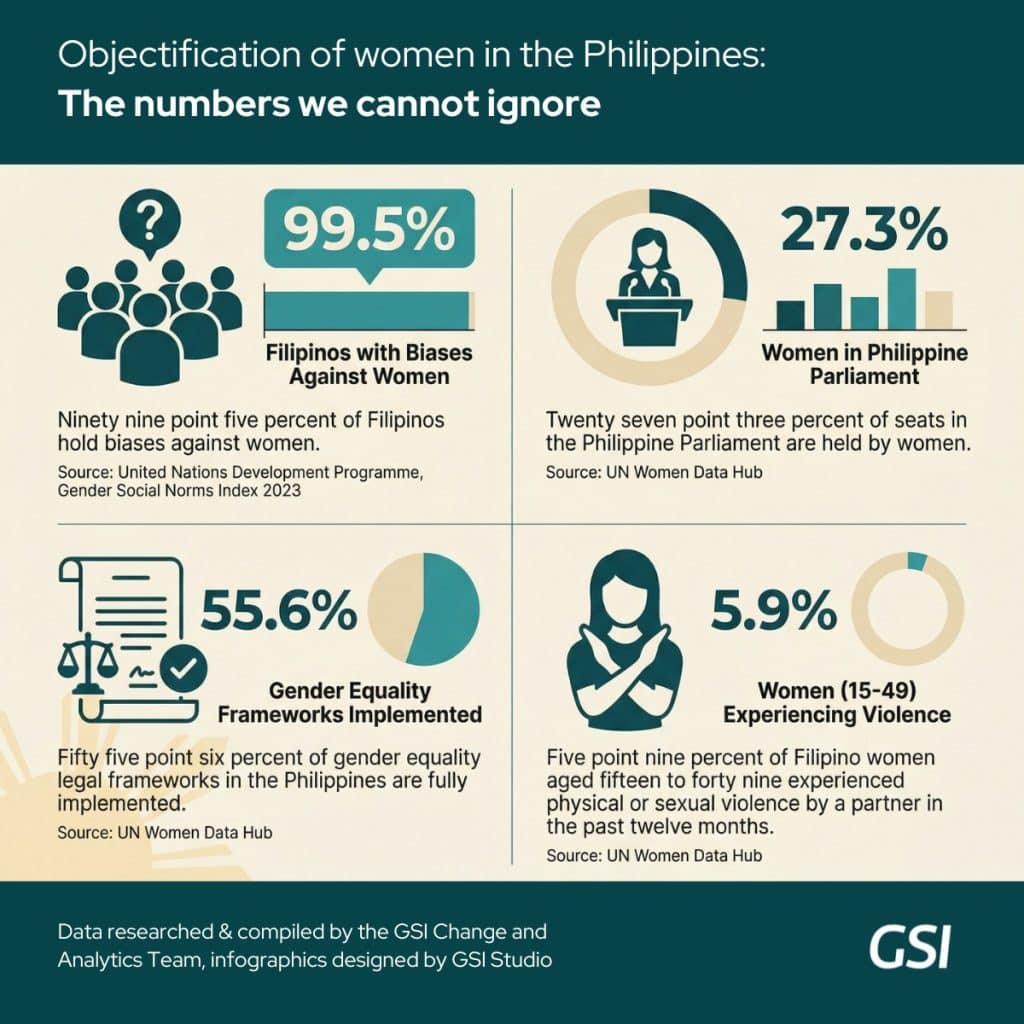
A study by the United Nations Development Programme in 2023 found that 99.5% of Filipinos hold biases against women, including beliefs that limit women’s rights and capabilities. This includes 99.3% of men and 99.7% of women. These numbers show how deeply gender bias is woven into everyday thinking and how normalised objectification has become.
Cultural Norms That Sustain Inequality
Patriarchal expectations continue to shape Filipino society. Women are still expected to be modest, accommodating, and careful not to offend. Media and entertainment often reinforce these expectations by portraying women as objects of desire or as comedic props.
Humour is one of the most powerful vehicles of sexism. Sexist jokes are often dismissed as harmless, which makes it difficult for women to speak up without being labelled overly sensitive. This dynamic protects the behaviour rather than the people harmed by it. When disrespect is framed as a joke, accountability becomes optional.
The Weight of Power and Public Influence
Objectification becomes even more damaging when it comes from people in positions of authority. Remarks from politicians, celebrities, and public officials carry influence. When leaders make sexist comments, they normalise disrespect and signal that women’s dignity is negotiable.
The Philippine Commission on Women and various advocacy groups have repeatedly condemned sexist behaviour in government, warning that it undermines gender equality and reinforces discrimination. Public institutions cannot champion equality while tolerating behaviour that diminishes women.
The Consequences for Women’s Lives
Objectification is not simply offensive. It creates conditions where harassment, discrimination, and violence become more likely. The findings of the United Nations Development Programme on widespread gender bias show how these attitudes shape daily interactions and institutional behaviour.
Structural inequality reinforces this environment. United Nations Women reports that only 27.3% of parliamentary seats in the Philippines are held by women, and only 55.6% of gender equality legal frameworks are fully in place. These gaps show how objectification intersects with representation, safety, and opportunity.
When women are reduced to appearance, their voices are easier to dismiss. When their dignity is treated as optional, their safety becomes negotiable.
The Digital Landscape
Social media has intensified both objectification and resistance. Filipino women face sexualised comments, harassment, and doxxing online. These behaviours mirror offline norms but spread faster and more aggressively. At the same time, digital platforms have become spaces where women and allies call out sexism, demand accountability, and support one another.
Online communities have made it harder for institutions to ignore sexist behaviour. Public pressure now builds quickly and visibly, and silence is increasingly seen as complicity.
Institutional and Community Responses
Government agencies, advocacy groups, and public figures have spoken out against objectification. Statements from Malacañang and the Philippine Commission on Women emphasise the need for dignity and respect in public discourse. Civil society continues to push for stronger enforcement of gender sensitive policies and better protection for women in workplaces, schools, and public spaces.
Despite these efforts, the Philippines still falls short of full gender equality implementation. Only 55.6% of legal frameworks are fully in place. This gap shows the need for stronger institutional commitment and consistent accountability.
What Real Change Requires
Ending objectification requires courage from individuals, institutions, and communities.
- Cultural change requires challenging sexist humour, teaching respect early, and encouraging men to be active allies.
- Institutional change requires enforcing gender sensitive policies, holding public officials accountable, and ensuring safe reporting mechanisms.
- Media change requires portraying women in diverse and empowered roles rather than relying on stereotypes.
These shifts are not symbolic. They shape how women are treated every day.
A Call to Reimagine Women’s Place in Society
The objectification of women in the Philippines is not a cultural quirk. It is a barrier to safety, dignity, and equality. It limits women’s participation in public life, reinforces harmful stereotypes, and contributes to a culture where violence and discrimination persist.
The country cannot move forward while half its population is reduced to appearance, entertainment, or ridicule. Women are full human beings with agency, intellect, and worth. Respect is not optional. It is the foundation of a just society.
Ang Objektipikasyon ng Kababaihan sa Pilipinas: Panawagan para sa Mas Matapang na Kultura
Maraming dahilan kung bakit pumipili ang mga babae kung paano sila manamit at magpakita ng sarili. Para ito sa kanilang comfort, identity, kultura, kumpiyansa, creativity, at sariling pagpapasya. Pero sa Pilipinas, buhay pa rin ang ugali ng pagtingin sa itsura ng babae na para bang ginawa ito para sa atensyon ng lalaki. Kapag ganito ang pananaw, nababawasan ang pagtingin sa kababaihan bilang may sariling desisyon at nagiging parang pag-aari ng publiko ang kanilang katawan.
Hindi ito simpleng isyu. Ito ang ugat ng objektipikasyon. Kapag ang hitsura ng babae ay parang bukas para sa komento, husga, o tsismis, mas madaling kalimutan na tao sila na may dignidad. Sa mga nakaraang buwan, ilang sexist na pahayag mula sa mga kilalang personalidad at opisyal ng gobyerno ang muling nagpasiklab ng diskusyon. Hindi ito mga simpleng pagkakamali. Sumasalamin ito sa mas malalim na kultura kung paano tinitingnan at tinatrato ang kababaihan sa bansa.
Paano Lumalabas ang Objektipikasyon sa Araw Araw
Ang objektipikasyon ay ang pagtingin sa babae bilang katawan, bilang aliw, o bilang papel na inaasahan ng lipunan. Sa Pilipinas, lumalabas ito sa mga unsolicited na komento tungkol sa katawan ng babae, green jokes, catcalling, at ang expectation na “dapat marunong kang makisama” kahit bastos na ang biro.
Ayon sa pag-aaral ng United Nations Development Programme noong 2023, 99% ng mga Pilipino ay may bias laban sa kababaihan. Kasama dito ang mga paniniwalang nagpapababa sa kakayahan at karapatan ng babae. Ibig sabihin, malalim ang ugat ng ganitong pag-iisip sa araw araw na buhay ng Pilipino.
Mga Kaugalian na Patuloy na Nagpapatibay sa Hindi Pagkakapantay Pantay
Malakas pa rin ang impluwensya ng patriyarkal na kultura sa Pilipinas. Inaasahan pa rin ang kababaihan na maging mahinhin, maunawain, at hindi nakakasakit ng loob. Sa media at entertainment, madalas silang ilarawan bilang object of desire o comic relief, hindi bilang kumpletong tao.
Malaki rin ang papel ng humor. Kapag ang sexist joke ay tinawag na “biro lang,” nawawala ang espasyo para magsabi ang babae na hindi ito tama. At kapag hindi puwedeng magsalita ang babae, mas lalo pang lumalakas ang kultura ng pananahimik at pagtitiis.
Kapag May Kapangyarihan ang Nambabastos
Mas mabigat ang epekto ng objektipikasyon kapag nanggagaling ito sa mga taong may impluwensya — politiko, celebrity, o opisyal. Malaki ang bigat ng salita nila. Kapag sila mismo ang gumagawa ng sexist remarks, para nilang sinasabing normal lang ang pambabastos.
Paulit ulit nang nagbabala ang Philippine Commission on Women at iba pang grupo na ang sexist behaviour sa gobyerno ay sumisira sa mga pagsisikap para sa gender equality. Hindi puwedeng mangako ng pagkakapantay pantay ang institusyon kung pinapayagan nito ang paglapastangan sa kababaihan.
Ang Totoong Epekto sa Buhay ng Kababaihan
Hindi lang nakakainsulto ang objektipikasyon. Nagbubukas ito ng pinto para sa harassment, diskriminasyon, at minsan pati karahasan. Ang malawak na gender bias na nakita sa pag-aaral ng UNDP ay nagpapakita kung paano naaapektuhan ang araw araw na pakikitungo sa kababaihan.
Ayon sa United Nations Women, 27% lamang ng mga puwesto sa Kongreso ang hawak ng kababaihan, at mahigit kalahati lamang ng mga batas para sa gender equality ang ganap na naipapatupad. Ipinapakita nito na ang objektipikasyon ay konektado sa representation, kaligtasan, at oportunidad.
Kapag hitsura ang basehan, mas madaling balewalain ang boses ng babae. Kapag dignidad ang nakataya, mas nagiging delikado ang kanilang kalagayan.
Ang Digital na Mundo
Mas pinalala ng social media ang objektipikasyon. Maraming kababaihan ang nakakatanggap ng sexualised comments, harassment, at minsan pati doxxing. Mabilis kumalat ang ganitong asal online, pero mabilis din ang pagbuo ng suporta at panawagan para sa accountability.
Sa digital spaces, mas nagiging malinaw na hindi na puwedeng palampasin ang sexist behaviour. Ang pananahimik ay nakikita na ngayon bilang pakikiayon.
Mga Tugon mula sa Institusyon at Komunidad
May mga pahayag mula sa Malacañang, Philippine Commission on Women, at iba pang organisasyon na nananawagan ng respeto at dignidad sa pampublikong diskurso. Patuloy ang civil society sa pagtulak para sa mas matibay na pagpapatupad ng gender sensitive policies at mas ligtas na espasyo para sa kababaihan.
Pero kahit may mga hakbang na, hindi pa rin sapat. Kalahati pa lamang ng mga batas para sa gender equality ang ganap na naipapatupad. Malinaw na kailangan ng mas seryosong commitment.
Ano ang Kailangan para sa Tunay na Pagbabago
Kailangan ng tapang mula sa bawat isa — indibidwal, institusyon, at komunidad.
- Kultura: Pagtutol sa sexist jokes, pagtuturo ng respeto mula pagkabata, at pag encourage sa mga lalaki na maging tunay na kakampi.
- Institusyon: Mahigpit na pagpapatupad ng gender sensitive policies at pananagutan para sa mga lumalabag.
- Media: Pagpapakita ng kababaihan bilang kumpleto at makapangyarihang tao, hindi bilang stereotype.
Hindi ito simpleng pagbabago. Ito ang magtatakda kung paano tinatrato ang kababaihan araw araw.
Panawagan para sa Isang Lipunang May Tunay na Paggalang
Ang objektipikasyon ng kababaihan sa Pilipinas ay hindi simpleng ugali o biro. Isa itong hadlang sa kaligtasan, dignidad, at pagkakapantay pantay. Nililimitahan nito ang partisipasyon ng kababaihan sa lipunan at pinapalakas ang mga stereotype na nagdudulot ng diskriminasyon at karahasan.
Hindi uusad ang bansa kung kalahati ng populasyon ay patuloy na binabawasan sa hitsura, aliw, o biro. Ang kababaihan ay may talino, boses, at halaga. Ang respeto ay hindi dapat pinag uusapan. Ito ang pundasyon ng isang makatarungan na lipunan.